











Brazil — one of Latin America’s largest and most dynamic economies — attracts entrepreneurs from all over the world. This guide explains how foreigners can open and run a company in Brazil, covering every step from legal requirements and taxation to real-world case studies of successful foreign founders.
Opening a Business in Brazil: Comprehensive Guide for Foreign Entrepreneurs
(2025)
Starting a business in Brazil
Brazil – the economic powerhouse of Latin America – offers immense
opportunities for entrepreneurs with its market of over 210 million consumers.
Foreign investors are allowed 100% ownership of businesses in Brazil, making
it an attractive destination for global entrepreneurs, including those from
Russia and other countries. However, turning this opportunity into a
successful enterprise means navigating Brazil’s complex bureaucracy, legal
requirements, and tax system. This guide provides a step-by-step
encyclopedia-level roadmap to as a foreigner, covering everything from
choosing a company structure and registering for a
CNPJ
to obtaining visas, permits, understanding taxation, and even real-world case
studies.
Whether you’re planning to open a café in Florianópolis or launch a tech
startup in São Paulo, this guide will walk you through every stage –
incorporating best practices and up-to-date (2025) information to ensure your
venture is set up for success.
Can Foreigners Open a Business in Brazil?
Foreigner meeting with a Brazilian lawyer and signing documents to
open a company
Yes. Brazil permits foreign individuals and companies to open and own
businesses with no requirement to have a Brazilian partner. In most sectors,
foreigners can even own 100% of the equity. But there are important legal
requirements and a few industry restrictions to be aware of:
Local Legal Representative: If a foreign owner does not reside in Brazil,
you must appoint a Brazilian resident as an official legal representative
(proxy) with power of attorney. This representative will act on your
behalf for tax, legal, and regulatory matters. Typically, the
representative can be a trusted lawyer or accountant in Brazil. (If you do
reside in Brazil, you can fulfill this role yourself as a managing
partner, but you’ll need the appropriate visa/status – see Visa section
below.)
Brazilian CPF Number: All foreign shareholders (individuals) and any
foreign directors must obtain a CPF (Cadastro de Pessoa Física), which is
the Brazilian individual taxpayer identification number. The CPF is
required to be listed in the company’s incorporation documents,
essentially to identify foreign investors to Brazilian authorities. A CPF
can be obtained from a Brazilian consulate abroad or directly from the
Federal Revenue (Receita Federal) in Brazil, even if you don’t live in
Brazil.
Registered Business Address: Your company must have a registered address
in Brazil (a physical location for the business headquarters). This can be
an office, commercial space, or even a virtual office address, as long as
it is a valid address where the company will be domiciled for legal
purposes. Different business activities have zoning requirements, so
ensure the address is allowed for the intended business (for example, some
home addresses may not be allowed for commercial activities requiring an
operating license).
Apostilles and Translations: If you have corporate documents from abroad
(e.g. a parent company’s documents, or power of attorney papers), they
must be apostilled in your home country and translated by a sworn
translator (tradução juramentada) into Portuguese. These legalized
documents will be needed during the company registration process.
Similarly, passports and proof of address might need to be officially
translated for certain filings.
Sectors with Restrictions: The vast majority of industries are open to
foreign-owned companies. However, a few sectors have restrictions or
special rules for foreign capital. For example, journalism and
broadcasting businesses have limits on foreign ownership; private security
companies must have 100% national (Brazilian) capital; acquisition of
rural properties in border areas by foreign-owned companies requires
special government authorization; and certain types of transportation
(especially related to aerospace or highway freight) may have
restrictions. Always check if your intended industry has any foreign
ownership caps or licensing hurdles. (Fortunately, in “the vast majority
of cases” there is no impediment – foreign investors can operate freely.)
Investor Visainvestor visa
Visa Considerations: You do not need a Brazilian visa or residency just to
open a company. In fact, the entire incorporation process can be done
remotely by granting power of attorney to your Brazilian representative.
Many foreigners open businesses in Brazil without ever setting foot in the
country – an appointed local lawyer can handle filings on your behalf.
However, if you plan to live in Brazil and actively manage the business,
you will need an appropriate visa or residency permit. The common pathway
is an (Permanent Residency), which typically requires a minimum investment of R$500,000 (approx.
USD $100k) in your Brazilian business. In recent years, Brazil introduced
a startup visa option requiring a lower investment (~R$150,000) if
invested in an approved innovative startup venture. If you obtain an ,
you’ll receive a CRNM (National Migration Registration Card), formerly
known as RNE, which proves your legal residency. (For those who only want
to run the business remotely or through local managers, no visa is
required – you can remain abroad and still be the owner.)
Documents for Foreigners: In summary, a foreign entrepreneur should have:
passport copies, proof of overseas address, Brazilian CPF number, and if
not residing in Brazil, the ID/CPF of the Brazilian representative. All
foreign documents must be apostilled and translated as needed. These will
be used in the preparation of the company’s Articles of Association and
for various registrations.
Real-World Note:
Opening a company in Brazil
involves many bureaucratic steps, and local expertise is crucial. As one
Russian entrepreneur cautioned, “Starting a company in Brazil is a process
with many nuances. Before relying on local specialists, you should at least
minimally understand the basics of legislation, tax law, and accounting,
otherwise you risk receiving low-quality services.” In other words, educate
yourself (as you’re doing now!) and choose trustworthy advisors – it will pay
off in avoiding delays and mistakes.
Choosing the Right Business Structure in Brazil
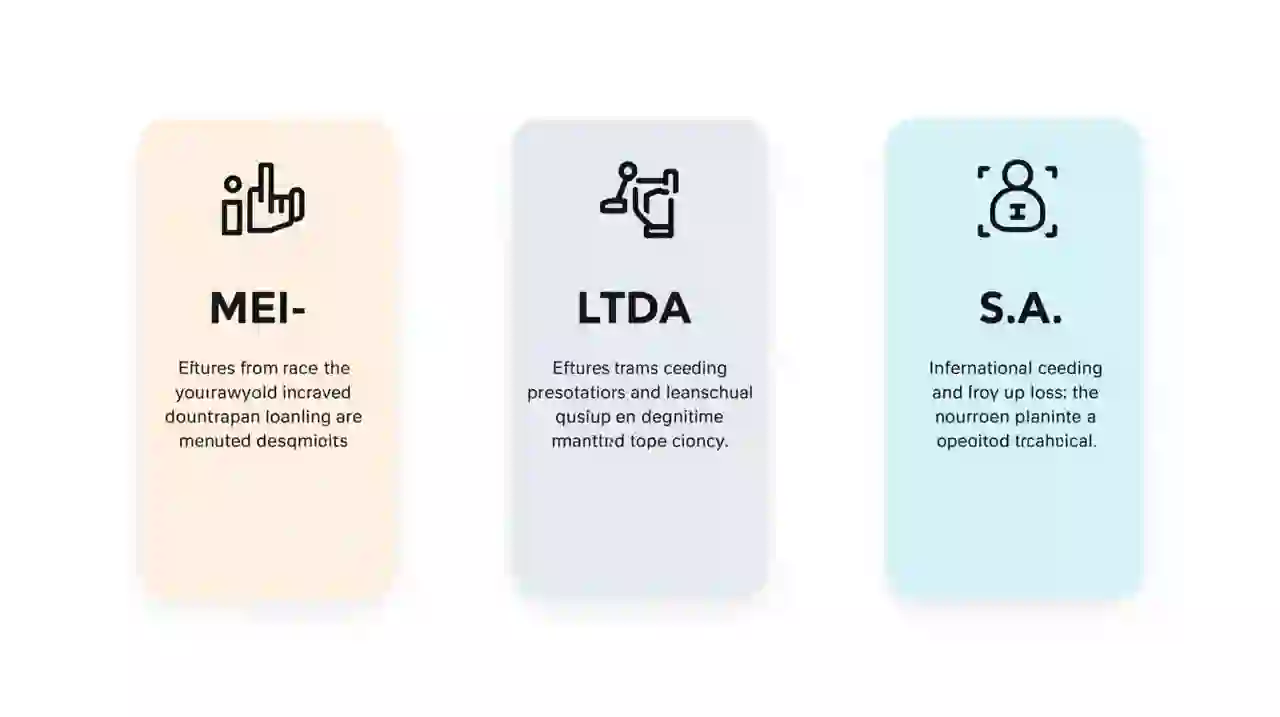
Comparison chart of MEI, LTDA and S.A. business structures in Brazil
One of the first decisions is selecting the legal structure for your new
company. Brazil offers several types of business entities, but foreign
entrepreneurs typically choose among a few key options. The choice will affect
your liability, tax obligations, ability to have partners, and regulatory
complexity. Below are the most common structures:
MEI (Microempreendedor Individual) – Individual Micro-Entrepreneur. This
is a simplified form of sole proprietorship for very small businesses. It
allows a single person to register as a company (with a
CNPJ) under
greatly simplified tax and reporting rules. MEI is capped at low revenue
(currently R$81,000 per year, about US$16k) and you cannot have business
partners or investors – it’s just you as the owner-operator. The upside is
a MEI pays only a fixed monthly tax (around R$60) covering all taxes and
social security, and has minimal bureaucracy. Foreigners can register as
MEI if they are legal residents in Brazil with an RNM (foreigner ID card)
– “Yes! If you are an immigrant you can also be MEI. You only need your
CRNM (RNE/RNM) number…”. For a newly arrived foreigner not yet holding
residency, MEI won’t be available; in that case, you’d choose another
structure below. MEI is ideal for freelancers, solo consultants, and small
traders starting out, including many digital entrepreneurs (e.g. an online
tutor or a craft seller could start as MEI). Keep in mind MEIs cannot have
employees (except one assistant) and if you exceed the revenue limit, you
must transition to a higher category.
LTDA (Sociedade Limitada) – Limited Liability Company (LLC). This is by
far the most common business structure in Brazil for companies of all
sizes, including those with foreign owners. An LTDA is a private company
that can have one or more owners (quotaholders) and provides limited
liability – your personal assets are protected, and liability is limited
to the capital invested. Historically, an LTDA required at least two
partners, but since 2019 it’s possible to form a single-member LTDA
(called Sociedade Limitada Unipessoal, SLU) without needing a second
shareholder – effectively replacing the old EIRELI form (see note below).
There is no minimum capital requirement for an LTDA by law (aside from
certain industries) – you can start with even R$1, though in practice you
should invest enough to cover startup costs and show credibility.
Foreigners can own 100% of an LTDA, and it’s the simplest vehicle for
foreign investment. An LTDA must have a Contrato Social (Articles of
Association) and comply with corporate formalities, but it’s less complex
than a corporation (S.A.). Most foreign-owned businesses in Brazil are
LTDA companies because of their flexibility – whether it’s a small
consulting firm or a medium-sized trading company. One thing to note: a
standard LTDA requires at least one administrator (manager) who must be a
Brazilian resident (either a citizen or foreigner with residency). This
ties back to the requirement of a local representative – typically the
administrador of the LTDA will be your Brazilian representative if you, as
a foreign owner, live abroad.
EIRELI (Empresa Individual de Responsabilidade Ltda.) – Individual Limited
Liability Enterprise. This form was essentially a one-person company with
limited liability, requiring a high minimum capital (at least 100 times
the Brazilian minimum wage). Important: As of 2021, Brazil eliminated new
EIRELI formations – the single-person LTDA (SLU) now serves the same
function without a capital requirement. Existing EIRELIs were converted to
LTDA entities. For practical purposes, foreign entrepreneurs no longer
need to use EIRELI; you would form an LTDA even if you’re the sole owner.
We mention it only because older resources reference EIRELI for sole
proprietors – but now a solo foreign investor can do an LTDA/SLU with no
Brazilian partner needed and no special capital, greatly simplifying
things.
A. (Sociedade Anônima) – Corporation or Joint-Stock Company. An S.A. is a
more complex legal entity akin to a C-corporation. It can be privately
held or publicly traded. S.A.’s are governed by a specific corporate law,
require a board of directors and an executive team, must publish financial
statements, and have more rigorous reporting. They allow raising capital
through shares, and are the structure required if you plan an IPO or to
issue certain securities. Foreigners can own S.A. shares, but an S.A. must
have at least 2 shareholders at all times (no single-shareholder S.A.).
Typically, small entrepreneurs do not choose S.A. due to cost and
complexity; it’s used by larger businesses or those needing equity
investors. If you have a startup that will seek venture capital, you might
consider migrating from LTDA to S.A. down the road. Initially, most start
as LTDA and later “upgrade” if necessary. For completeness: an S.A. also
has a minimum capital requirement if it’s publicly traded (and certain
industries like banking require S.A.), but an ordinary closed S.A. can
theoretically start with modest capital. The tax regime for S.A. is
usually Lucro Real (actual profit, see Tax section) by default, as they
can’t use
Simples Nacional
or other simplified regimes.
Other Forms: Brazil also recognizes Sole Proprietorship (Empresário
Individual) – basically a personal business without limited liability (not
advisable for most, since you’d be personally liable for debts). There are
also business cooperatives, partnerships, etc., but these are niche. In
almost all cases, a foreign entrepreneur will choose either an LTDA (with
either one or multiple partners) or operate as an MEI if qualifying as a
resident individual with a very small business. If you scale up
significantly, you might then incorporate as an S.A.
Below is a quick comparison of key features of common business forms:
Feature
MEI (Micro Entrepreneur)
LTDA (Limited Company)
S.A. (Corporation)
Allowed Owners
1 individual only (must be Brazilian or legal resident)
1 or more individuals or companies (foreign or local)
Minimum 2 shareholders (can be individuals or entities)
Liability
Unlimited personal liability (no separation of assets)
Limited liability (owners’ liability = their quota capital)
Limited liability (shareholders not personally liable)
Minimum Capital
None (no stated minimum; very low startup cost)
No legal minimum (a token capital is allowed, though adequate
funding is recommended)
No fixed minimum by law for private S.A., but substantial capital
needed for certain purposes (e.g. R$100k for public registration)
Tax Regime Eligibility
Simples Nacional only (default) – simplified micro-business tax
Can opt for: Simples Nacional (if qualifying as
small and no forbidden shareholders), or Presumed Profit, or
Actual Profit regimes
Cannot use Simples. Generally uses Presumed or
Actual Profit (large S.A.s must use Actual Profit)
Complexity & Compliance
Very low: Online registration, no formal
accounting needed (simple ledger), simplified annual reporting.
Moderate: Requires formal Articles of
Association, registration at commercial board, an accountant for
books and taxes, annual financial statements (though simpler than
S.A.).
High: Requires Board of Trade registration and
registration with CVM if public, a board and officers, published
financials, independent audits (if public), shareholder meetings,
etc.
Ideal For
Solo entrepreneurs (freelancers, artisans, small traders)
operating on a very small scale (≤ R$81k/year).
Small to medium businesses, typical startups, any foreign
investor-owned company. Most common choice for everything from
consultancies to restaurants to import/export firms.
Large businesses, companies planning to raise significant
investment or go public, or required sectors (e.g. banks,
insurance).
Note: If you plan to remain a very small enterprise, MEI offers extreme
simplicity. But if you expect to grow or have partners/investors (or if you
aren’t yet a resident), an LTDA is usually the way to go. Many foreign
entrepreneurs start an LTDA even as a single-person venture due to its
flexibility.
Also, be aware that
Simples Nacional
(simplified tax) regime (discussed later) is available only to certain types
of companies. Notably, a company that has another company as a shareholder
cannot opt for Simples. This means if your Brazilian company is owned by
another foreign company (instead of directly by you as an individual), it
might be barred from Simples. Most individual foreign entrepreneurs hold
shares personally, which is fine – you can still use Simples if you meet the
size criteria. The restriction is mainly if, say, “XYZ Corp (USA)” opens a
subsidiary in Brazil – that Brazilian company cannot use Simples due to having
a corporate shareholder. In such cases, the company must use the standard tax
regimes (Presumed or Actual Profit). We’ll dive into these regimes in the
Taxation section.
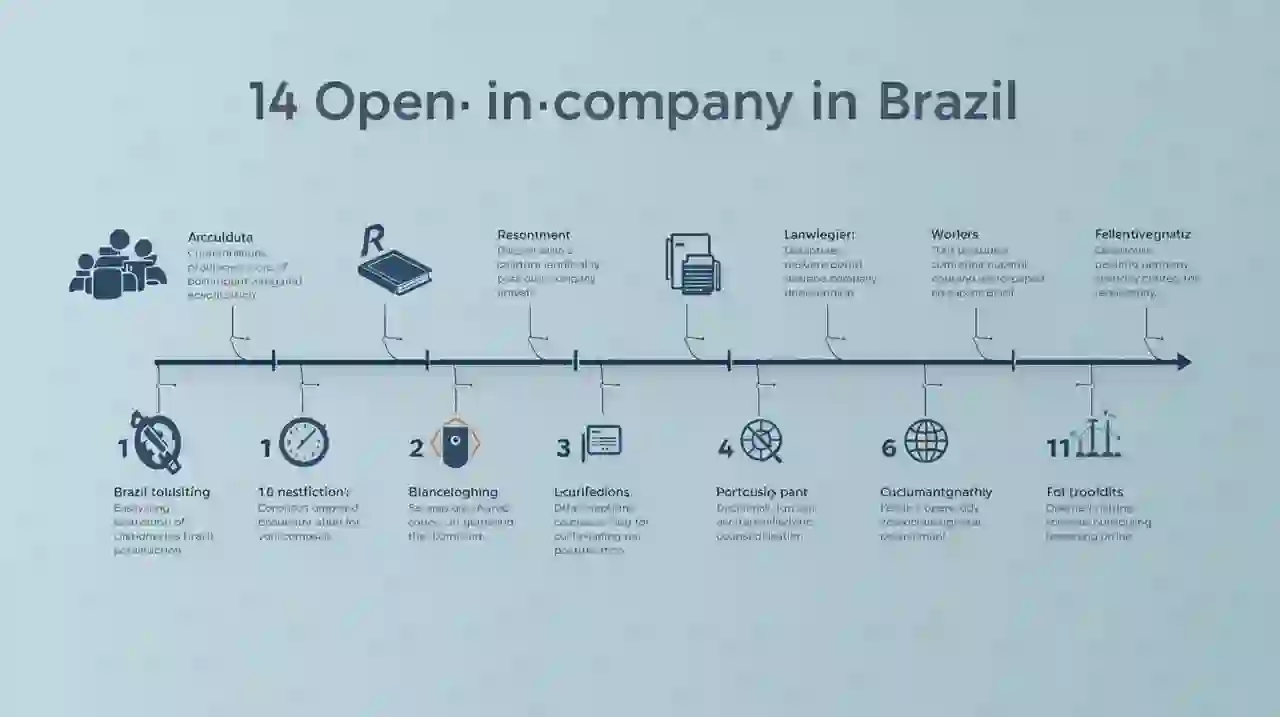
Step-by-Step Guide: How to Open a Business in Brazil (Foreigner’s Roadmap)
Step-by-step roadmap for opening a business in Brazil shown as a
timeline
Opening a business in Brazil
involves several sequential steps, dealing with different government agencies
at the federal, state, and municipal levels. Below is a comprehensive
step-by-step guide, from planning to post-registration, incorporating the
requirements we’ve discussed:
Step 1: Plan Your Business and Choose a Legal Structure
Before plunging into paperwork, clarify your business plan: What product or
service will you offer? Will you need a physical location or is it online? How
large do you expect it to grow? A solid plan will inform your choices in the
next steps.
Choose the appropriate business structure (MEI vs. LTDA vs. S.A., etc.) as
discussed in the previous section, based on your ownership and growth plans.
For most foreign entrepreneurs, the choice will be Sociedade Limitada (LTDA)
for its liability protection and flexibility. If you qualify and your business
is tiny, consider MEI for simplicity. If you’re setting up a major venture or
seeking investors, you might start planning for an S.A. but it’s usually not
the initial form.
Also, pick out a business name (or a few alternatives). Brazil requires that
company names be unique within the state and usually include a description of
the business activity. As part of the registration, you’ll conduct a name
availability search with the State Commercial Registry (Junta Comercial). For
now, have an idea of your desired name and a backup or two. The name typically
must have a designator (e.g., “Ltda.” at the end for an LTDA).
Step 2: Obtain a Brazilian CPF (Tax ID) for All Founders
Brazilian CPF number card and foreign passport on a desk
As noted, a CPF number is mandatory for any foreign individual who will be a
partner (shareholder) or director of the company. If you don’t already have
one, this is a first critical step. You can apply for a CPF from abroad at
your nearest Brazilian Consulate/Embassy, or in Brazil at a Banco do Brasil,
Caixa Econômica, or Correios branch, or online through the Receita Federal’s
system (for some nationalities). The process involves filling a form and
providing identification; if done abroad, the Consulate will forward the
request. CPF issuance is usually quick (same day) and costs very little or is
free.
Make sure each foreign shareholder (and any foreign person who will be listed
as a director/manager) has their own CPF. If any shareholder is a foreign
company rather than an individual, that company will need to obtain a
CNPJ
(corporate tax ID) in Brazil as a foreign entity, which is a bit more complex
– often handled later in tandem with incorporation. (Most often, foreign
entrepreneurs use personal names/CPF to register, unless it’s a large
international firm expanding into Brazil.)
Step 3: Appoint a Legal Representative (Proxy) in Brazil
Brazilian legal representative shaking hands with a foreign business
owner
If you (the owner) will not be residing in Brazil, you must appoint a legal
representative who is a resident of Brazil. This person will be your proxy
(procurador) for managing the company’s legal affairs with the government.
Commonly, people hire their law firm or accountant to fulfill this role, but
it could also be a trustworthy colleague or family member in Brazil.
The representative will need to sign a Power of Attorney (Procuração) prepared
by your lawyer, which authorizes them to act for you in incorporation and tax
matters. Your signature on this document (if signed abroad) must be notarized
and apostilled, and then translated to Portuguese. The power of attorney
typically states specific powers, like signing the incorporation papers,
representing before Receita Federal and Central Bank, etc..
If you are planning to move to Brazil immediately and have a residence visa in
process, you might be able to be present and sign as the administrator. But
even so, having a local proxy is highly useful for the incorporation process
and bureaucratic follow-up.
Tip: Choose someone reliable and experienced. They will essentially be the
face of your company to authorities until you can take over. Many foreign
entrepreneurs engage a lawyer to be the formal representative and an
accountant to handle tax registrations – some firms specialize in providing
this “representation” service. For instance, Martin Law states, “Our attorneys
can serve as your official legal representative in Brazil, handle all document
requirements, and guide you through every stage of incorporation” – such
services can ease the process but come with fees. If you go without a lawyer,
ensure your proxy understands Brazilian bureaucracy.
Step 4: Draft the Articles of Association (Contrato Social)
Now the actual company formation begins. You (and your partners, if any), with
help of a lawyer or accountant, will draft the Articles of Association (in
Portuguese: Contrato Social for LTDA, or Estatuto for S.A.). This is the
founding document of the company, equivalent to a partnership agreement or
bylaws. It will include key details such as:
Company Name and purpose.
Business Address (headquarters).
Partners (Quota Holders) names, nationalities, CPF/CNPJ
numbers, and their share in the capital.
Share Capital (Capital Social) – how much money (or assets) is being
invested into the company, and the division of quotas (shares) among
partners. (There’s no minimum for LTDA, but the amount should
realistically cover initial operations. You could start with a low amount
and increase later if needed. Importantly, if you are pursuing an
Investor Visa, note that the visa requires a certain capital injection – e.g. R$500k
or R$150k – which should be reflected in the capital and actually invested
in a Brazilian bank account.)
Company Administration – who will act as the administrator or manager (the
person with authority to represent the company legally). Typically one of
the partners (or an outsider) is named as the Administrador. If a
foreigner will be the administrator, they must have Brazilian residence.
If none of the foreign owners reside in Brazil, usually the legal
representative (proxy) is named as an interim administrator. You can later
change the administrator via an amendment when you (the owner) get your
visa or appoint someone else.
Business Activities – a description of what the company will do, often
referencing CNAE codes (the official classification of economic
activities).
Any special clauses like how profits will be distributed, how decisions
are made, arbitration clause, etc.
For an LTDA, the Contrato Social must be signed by all partners (or their
legal proxies via PoA). If signed abroad by you, it will need to be notarized,
apostilled, and translated, or you can sign it in Brazil with your proxy under
the power of attorney.
This step typically requires a Brazilian lawyer or experienced accountant to
prepare correctly. They will ensure it meets all legal requirements under the
Brazilian Civil Code and local Board of Trade regulations. Accuracy is
important – errors in the contract can cause rejection or future problems. For
example, Ksenia (the café owner from Russia) mentioned that her first
accountant made mistakes in the legal registrations, causing numerous
headaches later. Don’t let that happen – get the contract right from the
start.
Foreign Investment Registration: If any partner is a non-resident (which in
this case they are), after the company is formed, you will need to register
the foreign capital with the Central Bank of Brazil (we will cover this in
Step 8, but keep in mind it’s related to the capital you declare in the
Contrato Social). Essentially, Brazil tracks foreign direct investment through
an online system (RDE-IED), which you must update whenever you bring money in
or out. The initial capital must be reported, but this reporting is done after
you have the company’s
CNPJ
and bank account, not at the moment of drafting the contract. Just be aware
that whatever amount you declare as capital, you should plan to actually remit
to Brazil so it can be registered as FDI (this is what proves to the
government that you invested and allows future profit repatriation).
Step 5: Register the Company with the Board of Trade (Junta Comercial)
Documents being stamped at the Brazilian Board of Trade office
Once your constitutive act (Contrato Social or equivalent) is ready, the next
step is to register your company with the State’s Commercial Registry. Each
state in Brazil has a Junta Comercial that approves and archives company
incorporation documents.
Name Search: Before formal submission, a name availability check is done. Your
advisor can usually do this online. Reserve the name if possible. Then,
prepare the required documentation for filing which generally includes: - The
signed Contrato Social (or incorporation act), with translations if needed. -
Copies of partners’ documents (passports, CPF, proof of address, for
individuals; or corporate docs for any corporate partners, duly apostilled and
translated). - Proof of payment of registration fees (Junta Comercial has a
filing fee, which might be on the order of a few hundred reais depending on
the state). - Application forms provided by the Junta (some states have an
online portal where data is input and forms generated).
Submit these to the Junta Comercial of the state where your company will be
headquartered. Many states (like São Paulo, Rio, Santa Catarina, etc.) now
have online or integrated registration systems, meaning you might submit
electronically through a system called REDESIM or the Junta’s website. In
other states, you might need to submit physical documents.
Processing time: Historically, this could take several weeks (and Wise’s guide
still notes 60–90 days for the overall registration process). However, there
have been improvements. Some states have dramatically sped up approvals –
“States like São Paulo, Santa Catarina, and the Federal District now process
business registrations in one day” thanks to digital transformation. In the
best case, your company’s constitutive act could be approved within 1–5
business days. Let’s assume a couple of weeks for safety, as delays happen if
any document is missing or if there’s a high volume of filings.
When the Junta Comercial approves, they will officially register your company
and issue a document (proof of registration and a company registration number
at the Junta).
CNPJ
Simultaneous : Brazil has an integrated system such that upon Junta approval,
the data is forwarded to the federal tax authority (Receita Federal) to issue
your
CNPJ
(the National Registry of Legal Entities number). In many cases, you don’t
need a separate application for CNPJ – it comes automatically after the Junta
registration is confirmed. The CNPJ is analogous to a company’s tax ID or EIN.
It’s a 14-digit number formatted like XX.XXX.XXX/0001-YY.
Step 6: Obtain Your CNPJ and Register for Federal Taxes
Brazilian CNPJ certificate on a laptop screen next to a notebook
CNPJ
After Junta Comercial registration, you should receive your from the Receita
Federal (often this is an online certificate you can download from the
Receita’s website using the company name or Junta registration number). The
CNPJ
registration is what allows your company to exist as a legal entity for tax
purposes – “This number allows you to operate legally, issue invoices and hire
employees.”. Think of the CNPJ as the corporate identity number you’ll quote
on all invoices, contracts, and tax filings.
At this stage, your company is officially formed – congratulations! 🎉 But
it’s not ready to do business until you complete the next steps of tax and
license registrations.
CNPJ
Enroll Foreign Shareholders in CPF/: One sub-step often done at this point (if
not already completed) is making sure any foreign shareholder that is a legal
entity has been enrolled in the National Registry of Foreign Corporate
Taxpayers (CNPJ
for foreign company) and any individual shareholders have their CPF linked. In
practice, because you provided CPF for individuals and all needed data, this
is usually taken care of. If a foreign company was a partner, additional
filings with Receita Federal (through a specific form called DBE) might have
been necessary. Your legal representative typically handles this. Essentially,
by the time you have the CNPJ, Receita Federal knows the foreign ownership and
may require that the foreign investor has appointed a Brazilian tax
representative as well (often the same person as the legal rep).
Digital Certificate: It is highly recommended (and sometimes effectively
required) to obtain an e-CNPJ
(digital certificate) for your company at this point. This is a secure digital
ID (on a token or in the cloud) used to sign documents, issue Nota Fiscal
eletrônica (invoices), access government systems, etc. To get one, the legal
representative or administrator will go (in person) to an authorized
Certification Authority office with documents. This enables online tax
compliance. Many accounting firms will do this for you as part of their setup.
Step 7: Register with State and Municipal Authorities; Obtain Licenses
Wall with Brazilian business licenses and permits framed in an office
or café
With a
CNPJ
in hand, you must register your company with applicable state and city
authorities and obtain necessary operating licenses. This part ensures your
business is fully compliant to actually start operations:
CNPJICMS
State Registration (Inscrição Estadual): If your company will engage in
commerce (buying/selling goods), manufacturing, or other activities
subject to state tax (), you need to register with the State Department of
Finance for an Inscrição Estadual (IE). This is essentially a state tax
ID. For example, if you open a retail shop or import/export business, ICMS
(VAT on goods) applies and you must have IE to issue the required
invoices. Service-only companies (which pay
ISS, a city
tax) often do not need state IE unless they also sell products. Some
states automatically issue the IE together with the via the integrated
system. In others, your accountant must apply to the state’s SEFAZ
(finance secretariat) for the inscription.
CNPJ
Municipal Registration (Inscrição Municipal): Similarly, if your company
provides services, you must register with the Municipal Tax Authority
(city hall) to obtain an Inscrição Municipal (IM). This registration
allows you to pay the
ISS
(Service Tax) and also is required to obtain your alvará (business
license). Typically, once you have , you go to the city’s online system or
department (many large cities have online integration too) and apply for
the municipal registration. In some places, this is part of the integrated
REDESIM process. The IM number is used on service invoices (Nota Fiscal de
Serviços).
Operational License (Alvará de Funcionamento): This is the formal business
license from the city authorizing you to operate at a given location.
You’ll apply through the city government, often at the same time as the
municipal registration. You have to inform the business address and the
specific activity; the city will verify zoning laws to ensure your address
can host that type of business (for example, a factory can’t be in a
residential zone, a food business must meet health codes, etc.). Sometimes
fire department approval and building inspections are required before the
license is granted. Many cities issue a provisional license quickly if the
activity is low-risk, then follow up with inspections. Ensure you meet any
requirements (e.g. installing fire extinguishers, accessibility features
if you have a physical shop open to public, etc.).
Additional Permits: Depending on your industry, you may need special
permits:
Health and Sanitary Permit (Vigilância Sanitária): Required if you deal
with food, beverages, restaurants, medical services, cosmetics
manufacturing, etc. Basically anything impacting public health. This
usually involves an inspection by the health surveillance agency (often
referred to as VISA or Anvisa if federal-level).
Fire Department License (Habite-se or AVCB): If your business operates in
a commercial space, the fire department may need to inspect and issue a
safety certificate (AVCB in some states). For a small office, this might
be covered by the building’s certificate. For a restaurant or shop, you
definitely need one.
Environmental License: If your business could impact the environment (
factories, certain chemicals, even some software companies if they use
large generators, etc.), environmental agency approvals might be needed.
Professional licenses: Some activities (like engineering, law, medicine)
require the business and/or professionals to register with a professional
council (e.g., CREA for engineering firms, OAB for law firms).
Make sure to research the specific licenses for your line of business. For
most ordinary businesses (like opening a consulting firm, a café, a retail
store), the key ones are the municipal operating license and maybe a fire
inspection. If you’re doing something specialized (food production, education,
transportation), check the sector regulators.
Completing the state and municipal registrations essentially “activates” your
company for operation in all jurisdictions. At this point, you have all the
tax IDs required to collect and pay taxes on your activities.
ICMS
Nota Fiscal: Once registered with tax authorities, your company will need to
activate its electronic invoicing capability. Brazil requires businesses to
issue Nota Fiscal (NF) for sales of goods and services – these are official
electronic invoices that get reported to the government. There are different
systems: NF-e (model 55) for goods ( invoices) and NFS-e for services (ISS
invoices) by municipalities. You should: - Register for access to the NF-e
system (usually done automatically when you get IE and have a digital
certificate). - For services, register with the city’s Nota Fiscal service
online platform.
Each invoice series will use your
CNPJ, and you’ll
need your digital certificate to sign them. It’s critical to have this in
place before you make your first sale, because failing to issue required notas
can result in fines.
As Martin Law emphasizes in their checklist, “Activate electronic invoicing
(Nota Fiscal) by registering your company with the tax authorities’ digital
system.” This is often one of the final steps to be fully operational.
Step 8: Register Foreign Investment with the Central Bank (RDE-IED)
This step is unique to foreign-owned companies. Whenever foreign capital
enters Brazil as an investment in a company, the law requires it to be
registered in the Central Bank’s Electronic Declaratory Registry for Foreign
Direct Investment (RDE-IED). This is done online (often by your accounting or
law firm) through the Central Bank’s system (called Sisbacen).
Right after your company is set up and you have a Brazilian bank account (next
step), you’ll likely transfer the initial capital (the money you pledged as
capital in the Contrato Social) into the company’s Brazilian bank account.
Within 30 days of the funds arriving, you must report that inflow via the
RDE-IED system. You’ll log the amount, the date, the currency, the investor’s
details, and tie it to your company’s registration.
This registration serves a few purposes: - It legitimizes the investment as
FDI, proving that money came from abroad lawfully. - It is required to
repatriate capital or remit dividends later on. If you want to send profits
back to your home country, the bank will ask for proof that the capital was
registered, and that yearly economic-financial statements have been filed in
the Central Bank’s system (there is an annual declaration for foreign-owned
companies if assets or capital are above a certain threshold). - It keeps
Brazil’s statistics on foreign investment up-to-date (legal requirement).
Your legal representative or a specialized consultant can handle the RDE-IED
registration. It’s not a public process like Junta Comercial – it’s an
internal Central Bank filing. After the initial capital registration, you also
must update the system for any future changes: e.g. new capital contributions,
reinvestment of profits, distribution of dividends to foreigners, changes in
ownership percentages, etc. It’s wise to have an accountant manage this to
stay in compliance.
Skipping this step is dangerous – unregistered foreign investment can lead to
difficulties and fines, especially if you try to send money out. So don’t
overlook it. It’s a relatively quick online procedure if you have all data.
Step 9: Select Your Tax Regime and Set Up Accounting
Brazil’s tax system is multi-layered and you have to choose a tax regime for
your company that will determine how you calculate and pay taxes. Upon
registration, typically your company is by default in the Lucro Presumido
(Presumed Profit) regime unless you opt into
Simples Nacional
or are required to use Lucro Real (Actual Profit). Here’s a quick overview to
make that choice:
CNPJSimples Nacional: A simplified regime for small businesses (annual gross revenue up to
R$4.8 million). It consolidates federal, state, and municipal taxes into
one monthly payment. The tax rate is a percentage of gross revenue,
varying by industry and revenue level – starting around 4% to 6% for most
small services or commerce, and gradatively increasing in brackets.
Simples greatly reduces paperwork: you pay a single DAS tax boleto and
don’t have to file separate federal tax returns for each tax. Most new
small businesses prefer Simples if eligible, because of lower tax burdens
and simpler compliance. Foreign-owned companies can opt for Simples if and
only if they do not fall under exclusion criteria (as mentioned, having a
foreign company as a shareholder is an exclusion; having a partner that is
also an owner of a large company can be an exclusion; being in certain
sectors like finance, or being a branch of a foreign company, are
excluded). But a typical foreign individual setting up a startup can use
Simples – there is no rule forbidding foreign individual shareholders in
Simples. For example, if you open a small restaurant or an IT consulting
LTDA, you can likely elect Simples Nacional. You usually make this
election in January. New companies have a window (within 30 days of
issuance or by a certain date) to apply for Simples in the current year.
If you miss it, you operate under Presumed Profit for the year and then
switch to Simples the next January.
Lucro Presumido (Presumed Profit): This is a simplified regular regime for
medium businesses or those not eligible for Simples. Under Presumed
Profit, you pay corporate income taxes (IRPJ and CSLL) on a deemed profit
percentage of your revenue, rather than actual profit. For example, a
service business might have a presumed profit margin of 32% – meaning you
pay income taxes on 32% of your gross revenue, regardless of your actual
profit. The effective income tax rate would be 15% of that presumed profit
for IRPJ plus 9% CSLL, which works out to about 7.68% of gross revenue for
IRPJ+CSLL (plus there are
PIS/COFINS
taxes of ~3.65% on gross, etc.). If your actual profit is much higher than
the presumed margin, Presumed Profit is beneficial (because you’re taxed
only on the lower presumed amount). If your actual profit is lower, you
still pay on the higher presumed amount – so it can hurt low-margin
businesses. This regime requires quarterly calculations and paying of
taxes, but simpler bookkeeping than Lucro Real. Companies up to ~R$78
million annual revenue can use Presumed (above that must use Real). Many
foreign companies that aren’t on Simples use Presumed Profit because it’s
more straightforward than Actual and often results in lower tax if you
have decent margins.
Lucro Real (Actual Profit): This is the full regular regime required for
large companies (and certain sectors like banks). Under Lucro Real, you
calculate your net profit according to accounting principles and tax
adjustments, and pay 15% IRPJ on that profit (plus 10% surtax on profit
over R$240k/year), and 9% CSLL on profit. You also handle
PIS/COFINS
in a non-cumulative way (which means charging ~9.25% on gross revenue but
you can deduct credits for certain costs – similar to a VAT). Lucro Real
requires robust bookkeeping, monthly or quarterly tax calculations, and if
you have a loss, you might pay minimal tax, but if you profit, you pay on
actual amounts. It’s the most complex but the only option for some
companies (e.g., if your business is a finance company or if you surpass
the revenue threshold). Also, companies with very low profit margins might
voluntarily choose Lucro Real, since any profit below the presumed
percentages yields less tax than Presumido.
Simples NacionalChoosing the regime: When opening the company, discuss with your accountant
which regime fits your projected size and activity. , if available, is usually
best for small businesses due to significantly lower combined tax rates and
bureaucracy. For instance, under Simples a small services company might pay
~6% of revenue in taxes at start, whereas under Presumed Profit it could be
around 11–14%, and under Real Profit it could be up to ~34% of profit plus ~9%
of revenue in
PIS/COFINS. That
said, Simples has its limits and some growing startups eventually outgrow it
or are in activities not allowed.
Your accountant will formally register the company in the chosen tax regime
with the authorities (Simples application or relevant tax office notices for
Presumido/Real). If Simples is chosen, you’ll start filing the simplified
PGDAS each month. If Presumed/Real, you’ll need to file DCTF, EFD, SPED
accounting and other obligations – hence definitely requiring an accountant’s
assistance.
Accounting Setup: Brazil’s law mandates that every company (except MEI)
maintain contabilidade – official double-entry accounting records, even if you
are a one-person company. You’ll need to hire an accountant (Contador) or an
accounting firm. They will: - Register your company with labor and social
security systems if you have or will have employees (e.g., Cadastro Esocial,
INSS, FGTS employer registrations). - Handle your monthly bookkeeping,
payroll, and tax calculations. - Issue required tax forms and pay taxes via
DARF/GNRE/GPS as applicable. - Prepare annual financial statements (balance
sheet, income statement) and corporate income tax returns (like the ECF –
Escrituração Contábil Fiscal). - Ensure compliance with accessory obligations
(there are many, such as SPED files, economic declarations, etc., depending on
regime).
Given the complexity, allocate resources for accounting. Typical
small-business accounting fees in Brazil might range from a few hundred to a
couple thousand Reais per month depending on volume, but it’s money well spent
to stay compliant. As one guide noted, “Accounting Services (monthly) $100 –
$400” is a common cost range to budget.
CNPJ
Opening Corporate Bank Account: Once the company is up and running in legal
terms, you’ll want a business bank account in Brazil (Step 10 could be this,
but it usually happens around this time). Banks will require your , the
company’s constitutive documents, proof of registrations, and identification
of the owners and representatives. The account opening can take a few days to
a few weeks as banks do their compliance checks, especially for foreign
shareholders. It helps if your Brazilian representative or a partner has a
relationship with the bank. Having all required documents in hand (CNPJ
certificate, Junta Comercial registration, CPF of owners, proof of address,
etc.) will smooth the process. Large banks like Banco do Brasil, Itaú,
Bradesco, Santander all handle foreign-owned accounts. There’s also Nubank and
others, but some digital banks might not support corporate accounts for
foreign entities yet.
Tip: Consult more than one bank to compare fees (some banks may demand higher
minimum balances for companies with foreign owners). Also, note that to
transfer money from abroad as capital, you’ll likely need the bank’s
international department to guide you (they’ll code the incoming wire as
foreign investment). After the account is open and funded, remember to do the
Central Bank registration (previous step).
Step 10: Hiring Employees (Labor and Payroll Obligations)
Small multicultural team working together in a modern Brazilian office
If you plan to hire employees in Brazil, you must comply with the country’s
labor laws, which are quite extensive. First, as an employer, you need to: -
Register the company with the Social Security Institute (INSS) and the FGTS
(Guarantee Fund) systems. (Usually done by your accountant when the first hire
is made.) - Set up payroll systems to handle monthly salaries, income tax
withholding, social security contributions, and the mandatory 13th month
salary and paid leave, etc. - Adhere to minimum wage and possibly higher floor
wages if set by the industry or region.
Brazil uses an electronic labor system called eSocial where employers must
report all events (hiring, terminations, monthly payroll, etc.). Your
accountant will use eSocial to keep you compliant.
Key costs: Employers generally pay an additional ~28-30% on top of salaries in
social charges (INSS employer part, FGTS 8%, etc.), and there are strong
protections for employees (termination costs, etc.). Ensure you understand
these or get guidance before hiring. Some businesses start with contractors
(PJ) – i.e., hire other companies or individuals who bill you – but be
cautious because if someone works like an employee, you can’t just call them a
contractor without risk.
If you are a small operation without employees, you can skip this step. But
note, even if you don’t hire employees, you as an owner could be on the
payroll as a Pró-Labore (owner’s remuneration) which also triggers INSS
contribution. Many foreign owners initially take profits only (which are
tax-free in Brazil after corporate tax) rather than salary, but consult your
accountant on best approach for compensation.
By now, if you’ve followed Steps 1–10, your business is legally established
and ready to operate – you have all registrations (CNPJ, state, municipal), you have the necessary licenses to open your doors or
launch your website, and you have an accountant to handle ongoing compliance.
Congratulations, you can start doing business in Brazil! 🎊
CNPJCNPJBefore we
move on to special topics, let’s summarize the typical timeline and costs for
the process: - Timeline: If all documents are in order, foreign investors can
incorporate entirely remotely and sometimes surprisingly fast. According to
one 2025 report, in some cases business registration can be completed “in as
little as 24 hours” under new digital systems, though that likely refers to
receiving once documents are pre-prepared. A more typical timeline is 4–6
weeks to get everything done – factoring in time to gather/apostille
documents, Junta approval, and additional registrations. Some sources still
suggest 60–90 days for foreigners, especially if there are complications (like
delays in document translation or obtaining licenses). In 2025, expect the
core company registration (Junta + ) to be fairly quick (days to a couple
weeks), and ancillary steps (licenses, bank account, etc.) to take a few more
weeks. Always build in some buffer for unforeseen delays. - Costs: Official
fees themselves aren’t very high (Junta Comercial fees, notary, etc., might
sum to a few hundred USD). The bulk of cost can come from professional
services and document prep. A law firm or consultancy package to open a
company for a foreigner can range from $3,000 to $10,000 USD depending on
complexity. This would include translations, notarizations, legal fees, and
initial accounting setup. If you handle everything yourself (and have
Portuguese fluency and knowledge to navigate), the out-of-pocket costs could
be under $500 (this would be mainly fees and translations). Keep in mind
ongoing costs: accounting services ($100–$400/month), perhaps a virtual office
address service if needed, etc. And of course, the initial capital you invest
is your own money but must be substantial enough if you’re pursuing an
investor visa
(e.g., R$500k). Budget accordingly for a smooth start.
Taxation and Accounting in Brazil: What Foreign Business Owners Must Know
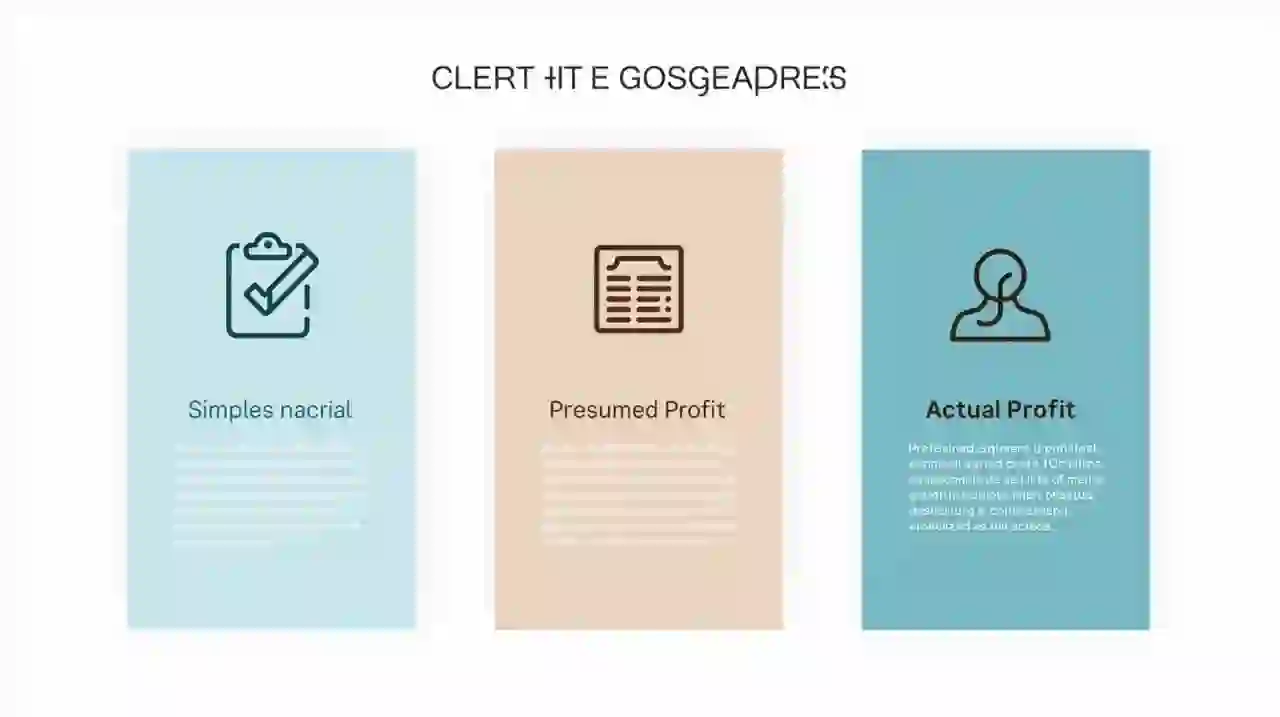
Infographic of Brazilian tax regimes Simples Nacional, Presumed Profit
and Actual Profit
Brazil’s tax environment is known for its complexity – multiple taxes at
federal, state, municipal levels – but with proper planning you can manage it
and even benefit from simplified regimes.
Here’s a breakdown of key taxes and regimes:
Corporate Income Tax (IRPJ) and Social Contribution (CSLL): Together,
these function like the corporate profits tax. The base rate is 15% on
taxable income plus an additional 10% surtax on profits above
R$240,000/year. CSLL is an additional 9% on profit. So effectively, under
a standard regime a profitable company might pay 34% of its net profit in
combined federal profit taxes. However, under
Simples Nacional, these income taxes are folded into the single tax and come out to a
much smaller percentage of revenue for small firms. Under Presumed Profit,
the 15%+10% IRPJ and 9% CSLL are applied to presumed profit margins (as
described earlier), often resulting in an effective rate much lower than
34% of actual profit (depending on margins). Under Actual Profit, you pay
based on real profit at the full rates (but can offset losses from
previous years up to 30%, etc.).
Tax on Gross Revenues –
PIS/COFINS:
These are federal contributions on gross revenue. In Simples, they’re
included in the one tax. In Presumed Profit, PIS+COFINS are calculated on
gross sales at combined 3.65% (cumulative system). In Actual Profit, they
are non-cumulative at 9.25% but with credits for inputs (like a VAT).
These are significant and often end up being a big tax cost for companies
outside Simples. Again, many small businesses avoid this by qualifying for
Simples where these are lower.
ICMS
(Imposto sobre Circulação de Mercadorias e Serviços): A state-level VAT on
goods and certain services (like transportation and communication). Rates
range ~17% to 19% in most states (with some interstate rate differences
and exceptions). If you sell physical goods or certain digital goods, you
will encounter
ICMS. Under
Simples, ICMS is part of the single tax (for example, a small retailer
under Simples might pay a total rate of 4-5% that includes ICMS). Outside
Simples, ICMS is charged on each sale, and you can usually get credits for
ICMS paid on inputs. It requires monthly filings per state.
ISS
(Imposto sobre Serviços): A municipal service tax on services, generally
2% to 5% of service revenue, depending on the city and service type. For
example, São Paulo and Rio often impose 5%
ISS
on most services. Under Simples, ISS is included in the single tax and at
lower effective rates for small revenue. If not in Simples, service
companies must collect and pay ISS to each city where services are
provided. If you invoice clients in different municipalities, you may need
to register in each of those or use the client’s ISS retention, etc. It
can be complex if you have nationwide service sales.
Payroll Taxes: If you have employees, you’ll pay INSS employer
contributions (~20% of wages) and other labor taxes (FGTS 8%, etc.).
Simples companies get some breaks (Simples businesses don’t pay certain
payroll taxes to entities like SEBRAE, SESI, etc.), but still pay INSS and
FGTS.
Brazil also has a dividend exemption – profits after corporate taxes can be
distributed to owners without further personal tax (as of 2025). This has made
it common for owner-managers to take a modest salary (taxed via payroll) and
the rest as dividends tax-free. Note: There are proposals to tax dividends in
future tax reforms, but none enacted yet; keep an eye on legislative changes.
ICMS
Upcoming Tax Reform: Brazil approved in 2023–2024 a major tax reform to
simplify consumption taxes by creating a dual VAT (the CBS federal and IBS
state) to eventually replace PIS, COFINS, ,
ISS, etc.. This
will be phased in from 2026 onwards. While the exact impact is beyond this
guide, the goal is to make things easier long-term. For now, anyone doing
business in Brazil must contend with the current system – multiple filings –
which underscores why having competent accounting support is vital.
Accounting and Compliance: By law, your company must keep accounting books and
file various tax returns: - SPED Accounting and SPED Fiscal: electronic
submissions of your accounts and tax calculations (for non-Simples companies).
- DCTF: a federal tax debts declaration. - ECF (Escrituração Contábil Fiscal):
annual corporate income tax return detailing profits and taxes. - ECD
(Escrituração Contábil Digital): annual submission of your general ledger (if
required, usually for larger companies or those under Real regime). - Simples
companies file a simplified monthly DAS and an annual DASN-Simei (for MEI) or
DEFIS (for Simples) declaring revenue.
Hire an Accountant: This cannot be stressed enough. As a foreign business
owner, Brazilian accounting and tax reporting will likely be the most
challenging aspect. A good accountant will ensure: - Your invoices (Notas
Fiscais) are properly issued and recorded. - Your taxes are calculated
correctly under your regime and paid on time (missing deadlines leads to fines
quickly). - Your company books are kept in accordance with Brazilian GAAP
(which is converging to IFRS for larger companies). - All those acronyms
(DCTF, SPED, ECF, RAIS, DIRF, etc.) are handled.
In one foreign entrepreneur’s experience, failing to have a competent
accountant from the start led to “registration errors in various agencies, tax
and customs difficulties, and a company that couldn’t operate for 2 months”.
She later had to fix those issues at great effort. So, see your accounting and
compliance cost as an investment in peace of mind and longevity of your
business.
Special Considerations for Digital Businesses (Online, Tech, SaaS, etc.)
Developer running an online business from a laptop with Brazilian
payment icons
In the modern economy, many foreign entrepreneurs are interested in running
digital businesses in Brazil – whether it’s an online service, a SaaS product,
an e-commerce store, or a content creation platform. The good news is that the
fundamental process of opening the business is the same as described above.
But there are a few additional points to consider for digital enterprises:
No Physical Presence Required (but Address Still Needed): You might be
able to operate an online business from anywhere, but Brazilian law still
requires a registered local address for your company and often a local
bank account for transactions in local currency. You might not need a
storefront or office – many digital entrepreneurs use a co-working space
or virtual office address to register the company. Make sure to check
zoning – even home-based digital businesses may need to ensure their
address is allowed for a business (some municipalities allow home offices
for software/consulting companies without issue).
MEI and Small Digital Entrepreneurs: If you are a content creator,
freelance programmer, or run a small online shop, you might qualify as an
MEI (if you have residency). Many digital solopreneurs in Brazil use MEI
because it covers numerous occupations (including “web designer”, “online
sales”, “photographer”, etc.) and greatly simplifies tax to a small fixed
amount. MEI is attractive for side hustles or testing a business concept
online. Once revenue grows beyond the limit (R$81k/year currently) or if
you need to take on partners, you’d transition to a normal company
(Simples).
E-commerce (Physical Products): If your digital business involves selling
physical goods through an online marketplace or store, you will have to
deal with ICMS and shipping logistics. Brazil’s ICMS for e-commerce can be
complicated by interstate tax split rules (difal). As a small e-commerce
under Simples, the system handles a lot of it via the Simples DAS.
Marketplaces like Mercado Livre or Amazon require you to have a
CNPJ
(if you’re doing it as a company) and to issue notas for sales. They
sometimes facilitate tax collection for interstate sales. Ensure your
accountant sets up the correct product codes (NCM) and that you understand
postal requirements (e.g., including CPF/CNPJ of customers on shipments).
Also, consider using fulfillment services if you’re overseas – but note
that running a Brazil-based e-commerce from abroad is tough due to import
costs; many foreigners instead partner with locals or drop-ship
domestically.
SaaS and Export of Services: If you run a Software-as-a-Service or other
online service that has customers outside Brazil, you should know about
tax benefits for exports. Brazil generally does not tax export revenue for
services – for example, ISS (municipal service tax) often is exempt when
the service is provided to clients abroad (the rationale being the service
is “consumed” outside Brazil). Also,
PIS/COFINS
on export revenues can be zero-rated. This means a tech startup in Brazil
serving a global market might pay no ISS and no PIS/COFINS on its foreign
sales (and just the corporate taxes on profits). You may need to provide
documentation that funds received are from overseas for services performed
(e.g., software development for a foreign client). Check the local
municipal law – many follow the federal guidance of not taxing exports of
services. This can make Brazil an interesting base for
international-oriented digital businesses, potentially enjoying low tax on
foreign income.
Local Sales of Digital Goods/Services: If your SaaS or app targets
Brazilian customers, you will be subject to local taxes. Software and
digital services
taxation in Brazil
has been a gray area – whether it’s ISS or ICMS. Recent consensus tends
towards ISS for software services (with a few exceptions). So your SaaS
fees to Brazilian clients likely incur ISS (2–5%). Some cloud or streaming
services might be deemed communication services subject to ICMS. Also be
aware of a special contribution called CIDE on remittances for technology
or royalties (if you pay money out of Brazil for software licenses or tech
services, a 10% CIDE might apply). For purely domestic digital sales,
consider consulting a tax advisor to ensure you apply the correct tax. In
the near future, the tax reform’s new VAT will unify this anyway.
Data Protection (LGPD): Running an online business means handling user
data. Brazil has a General Data Protection Law (LGPD) similar to Europe’s
GDPR. If you collect personal data (names, emails, etc.), you must comply
with LGPD principles (obtain consent or have another legal basis, secure
the data, etc.). Ensure your website/app has a privacy policy aligned with
LGPD. Non-compliance can lead to fines, though enforcement is still
ramping up.
Online Payments and Fintech: Brazil’s consumers often use local payment
methods (boleto bancário, Pix instant payments, local credit cards). To
accept these, you’ll integrate with a payment gateway or processor
(PagSeguro, MercadoPago, Stripe Brazil, etc.). To set up those accounts,
you’ll need your
CNPJ
and bank account. Fintech innovation is strong – Pix (an instant payment
system) is ubiquitous now. Make sure to offer Pix for online sales – it’s
easy once you have a bank account. If your business is fintech (like
dealing with payment services or crypto), note that there are additional
regulations and you might need licenses from the Central Bank or CVM
depending on the model.
Tech Startup Incentives: Brazil has programs to encourage tech startups –
for example, the government’s Startup Brasil initiative, various
incubators and accelerators (some offer support to foreign-founded
startups too). Some states have tax incentives for tech companies (often
via reduction in
ISS
or providing grants for R&D). Research if there’s a tech park or
incubator in your city – joining one might ease some bureaucratic
processes and offer mentorship. Also, SEBRAE, the Brazilian Small Business
Support Service, provides a lot of free or low-cost courses and consulting
for new businesses – they even have tech-oriented programs. Even if
materials are in Portuguese, as a foreigner you can avail of SEBRAE’s help
for, say, refining your business plan or understanding compliance.
Digital VAT for cross-border services: Outside the scope of company
registration, but worth noting: If you are a foreign company selling
digital services to Brazilian consumers (without a local entity), Brazil
charges a “Netflix tax” (ISS
on imported service, or recently they talk of a digital services tax). But
since you’re setting up a local entity, you’ll be charging Brazilian
customers with local taxes as discussed.
In summary, a digital business in Brazil faces largely the same formation
process as any other business. The differences emerge in the operational phase
– dealing with possibly fewer physical permits (no brick-and-mortar concerns)
but needing to navigate intellectual property, data, and an evolving digital
tax landscape. Keep your accounting robust (digital or not, all companies file
taxes!), and consider consulting specialized tech legal counsel for things
like user terms, data policies, and any needed trademark registrations.
Brazil has a large and growing online market – e-commerce revenue is expected
to hit $45 billion in 2025 – and also a thriving tech talent pool (over
475,000 tech graduates annually in Brazil). As a foreign tech entrepreneur,
you can tap into this ecosystem. Setting up your company properly will enable
you to hire local developers, contract Brazilian clients, and potentially
qualify for Brazilian innovation grants or tax benefits.
Additional Resources and Downloads
Happy foreign family and baby walking in a Brazilian city with
skyscrapers in the background
To complement this guide, here are some official resources and tools that can
help foreign entrepreneurs navigating the process:
Ministério da Economia – Empresa Portal (): The Brazilian government’s
portal for opening businesses (REDESIM). Contains step-by-step checklists
(in Portuguese) and links to each state’s online registration system.
Start at the page for Empresas or the specific Junta Comercial of your
state.
Receita Federal –
CNPJ
and CPF Information: Official info on obtaining a CPF and registering
CNPJ, including the online verification tool for CNPJs. The Receita site (
also has downloadable forms and manuals (in Portuguese).
Apex-Brasil (Trade & Investment Promotion Agency): ApexBrasil provides
guidance to foreign investors, including sector opportunities and can
assist with understanding incentives. They have English materials on doing
business in Brazil.
SEBRAE: A resource for small business (mostly in Portuguese). They offer
free courses on opening a business, including legal aspects and business
plan writing.
Brazilian Consulate Websites: If you need a visa or CPF abroad, the
consulate site for your country will have instructions and forms for CPF
and investor visas. The Ministry of Foreign Affairs (Itamaraty) portal
lists visa types and requirements (e.g., the
investor visa
requiring R$500k or R$150k for startups).
Downloadable Guide (PDF): We have prepared a comprehensive PDF guide
consolidating this information in a more portable format, including
checklists and a diagram of the registration process. (Download here:
[link]). (This PDF includes a flowchart of the steps and a one-page
checklist for quick reference.)
(If the PDF download link is not accessible in this text-only format, please
refer to our website’s “Guide to
Opening a Business in Brazil” section to download the PDF.)
Real-Life Case Studies: Successes and Lessons from Foreign Entrepreneurs in
Brazil
To put all this information into perspective, let’s look at a couple of
real-world examples of foreigners who navigated the process of starting
businesses in Brazil. These cases illustrate the challenges and rewards of
entrepreneurship in this country.
Case Study 1: Ksenia’s Café in Florianópolis
Female foreign entrepreneur in a bakery café in Florianópolis, Brazil
Ksenia Balickaya is an entrepreneur from Russia who moved to Florianópolis,
Brazil, and fulfilled her dream of opening a café and bakery. Ksenia’s café
specializes in healthy breakfast foods and even introduced a product new to
the local market – thin Armenian lavash bread – which she produces and sells.
Her story sheds light on the ground-level challenges a foreigner can face:
Navigating Bureaucracy & Choosing the Right Advisors: Ksenia learned
the hard way that you must choose your local accountant/consultant
carefully. She initially hired a bookkeeper (“Antonio”) to help open the
company, but he made numerous mistakes in the registration process. As a
result, critical steps were left incomplete – her company wasn’t fully
registered with all agencies, meaning it legally “could not function for 2
months” after the initial paperwork. Each time she discovered a missing
registration (tax, customs, etc.), that accountant demanded extra fees.
She later found out he was overcharging – “the cost for registering the
company as an importer was 5 times the market rate, simply because I
didn’t know the procedures”. Lesson: Do your homework and get second
opinions. Unscrupulous providers might take advantage of a foreigner’s
unfamiliarity. It’s wise to engage a reputable firm or get referrals from
other expats.
Understanding Legal Requirements: Ksenia also encountered Brazil’s strict
labor protections in a surprising way. When parting ways with that bad
accountant, she had to be extremely cautious – in Brazil, even contractors
can sometimes sue for perceived damages. She notes that local
professionals “can take you to court if they feel they worked more than
paid, and the law strongly protects workers – 95% of the time they win
such cases”. She had to obtain written confirmation that neither party
owed anything to safely terminate the service. This highlights how
Brazil’s legal environment can be very different from elsewhere – one must
document everything and follow proper procedures when ending contracts or
employment.
Importing Equipment & Regulatory Hurdles: To support her café, Ksenia
imported a special oven for baking lavash from abroad. This brought
additional complexity: she needed to register her company as an importer
with customs, get an import license for the equipment’s product code, and
handle customs clearance. Because of earlier missteps in registration by
her accountant, when the oven arrived at customs it was held up – the
import code was initially not allowed and her company hadn’t been properly
set up in the import system. She had to scramble to purchase a different
import license and get a new customs declarant to resolve the issue. The
oven eventually cleared, but it delayed her bakery production
significantly. This underscores: if your business involves imports
(bringing in equipment or products), factor in the extra layer of
import/export regulations. You’ll need a RADAR license (importer’s
license) and to follow Brazilian customs procedures. Many new foreign
businesses might ignore this if they assume they can ship things in easily
– not so, you must plan for it.
Despite the rocky start, Ksenia’s café did get up and running. She used the
downtime to learn as much as possible about Brazilian tax and accounting rules
herself, even writing a guide for friends to avoid the pitfalls she
encountered. Her resilience paid off – by understanding the system better, she
took control of her business. Now she runs a growing café and lavash
production in Florianópolis, with an eye to scaling further in Brazil’s food
industry.
Key takeaways from Ksenia’s experience: - Invest time in research and
understanding local regulations, even if you have consultants. It will help
you supervise their work and avoid being misled. - Choose reliable, referenced
professionals to assist in company setup. Sometimes paying a bit more for a
well-reviewed law firm or accountant is worth it. - Prepare for additional
requirements if doing specific activities (like importing or dealing with
health regulations for food). - Embrace learning: Ksenia turned her challenges
into expertise that now saves her and others money and trouble.
Case Study 2: EBAC Online – A Russian Tech Startup Thriving in Brazil
Online design students learning together on laptops in a modern
classroom
Not all foreign business stories in Brazil are cautionary tales – many are
successes showing Brazil’s potential. One example is EBAC Online, an online
creative arts and design school. EBAC (Escola Britânica de Artes Criativas)
Online was launched in 2020 by Russian entrepreneurs Pavel Aleshin, Andrey
Anishchenko, Alexander Avramov, together with Brazilian partner Rafael
Steinhauser. They chose Brazil as the headquarters for this e-learning startup
and it has flourished, attracting major investors and expanding across Latin
America. By 2022, EBAC Online had raised about $12.5 million from venture
funds including Baring Vostok and others – a significant achievement for a
foreign-founded startup in Brazil.
What does the EBAC case illustrate? - Brazil as a Tech Market: The fact that
Russian founders picked Brazil to launch a tech education platform underscores
the opportunity they saw: Brazil’s huge population of young people eager to
learn digital skills. Rather than launching in the overcrowded markets of U.S.
or Europe, they identified a gap in Brazil and localized their product for
Portuguese-speaking audiences. The startup’s success (future “unicorn”
potential per Forbes Russia) shows that foreign founders can indeed tap into
Brazil’s growing demand for tech services and education. - Local Partnerships:
The inclusion of a Brazilian co-founder (Steinhauser) likely helped navigate
local business culture and networks. This is a common success factor – while
100% foreign ownership is allowed, having a local partner or key hires who
understand the Brazilian market can accelerate growth and help avoid pitfalls
in operations. - Leveraging Incentives: Although not detailed in the snippet,
a startup like EBAC could leverage some of Brazil’s innovation incentives. The
government’s focus on tech (from startup visas for founders to programs like
PEIEX for exporters or tax breaks for tech investments) can be advantageous.
Also, foreign-led startups often benefit from local accelerators (e.g., Cubo
Itaú, Endeavor, etc., many of which welcome foreign founders). - Persistence
in Bureaucracy: It’s not public, but surely EBAC’s team had to go through the
same steps – CPF,
CNPJ, etc. –
that we discussed. The difference is they were likely well-advised (perhaps by
venture attorneys) and capitalized enough to hire top legal/accounting help.
When aiming big (raising millions), one can’t afford compliance mistakes. This
suggests if you have a high-growth startup idea, it’s worth investing in
top-tier legal counsel in Brazil to set up correctly from day one (structure,
intellectual property, employment contracts, etc. in place).
Today, EBAC Online is headquartered in São Paulo (the hub of Brazil’s startup
scene) and is expanding regionally. It stands as proof that foreign
entrepreneurs can not only
start a business in Brazil
but scale it successfully, given a strong value proposition and adaptation to
the local market.
Key takeaways from EBAC’s success: - Brazil’s large market can catapult a
startup to scale quickly – especially in tech and online sectors where user
bases grow fast. - Adapt to local needs: EBAC did an online education platform
tailored to Brazilian learners. For you, whatever your business, localize your
offering (language, preferences, pricing model, etc.). - Work within the
system: Comply with regulations, but also use government programs that exist
to help (they had Brazilian leadership and likely used local grants or
connections). - Networking: São Paulo’s tech ecosystem is vibrant. Engaging
with local startup communities (meetups, investor events) as a foreign founder
is crucial – it’s a smaller world than, say, Silicon Valley, and people are
very welcoming to foreign innovators, given Brazil’s hunger for tech
solutions.
Case Study 3: (Hypothetical) Roberto’s IT Consulting in São Paulo
(While not drawn from a single published story, this composite case reflects
common experiences of foreigners, including Russians, who have opened small IT
or consulting businesses in Brazil.)
“Roberto” is a software developer from Russia who moved to São Paulo and
started a boutique IT consulting firm. He set up a Sociedade Limitada with one
Brazilian friend as a minor partner (mainly to have a local administrator
while Roberto was waiting on his
investor visa). The business provides custom software development services for Brazilian
companies.
Roberto opted for
Simples Nacional
As an LTDA with himself (foreign individual) and a Brazilian partner, the
company was eligible. This kept his taxes low – roughly 6% on revenues
initially – and compliance straightforward, managed by a part-time
accountant. He noted that if he had instead opened the company as a wholly
foreign-owned subsidiary of his existing overseas company, he wouldn’t
have gotten Simples status. By registering personally, he saved
significantly on taxes. This highlights the benefit for small foreign
entrepreneurs to own the business directly as individuals rather than
through a foreign holding entity, at least until the business grows.
One challenge Roberto faced was the language and cultural barrier in
business settings. Negotiating contracts in Portuguese and understanding
Brazilian clients’ expectations took some adjustment. He took intensive
Portuguese classes and hired a bilingual sales representative to help
interface with clients. For legal contracts, he invested in professional
translations to ensure nothing was lost in translation. Brazil operates in
Portuguese, so foreign founders must adapt linguistically for day-to-day
operations, even though many educated Brazilians speak English.
Roberto’s IT firm benefited from Brazil’s abundant tech talent. He was
able to hire two junior developers from the local university at
competitive salaries. However, he had to quickly learn Brazil’s labor
laws; for instance, he discovered that the cost of an employee is about
70% on top of their salary when including taxes, benefits, paid vacations,
13th salary, etc. To keep flexible, he initially engaged some freelancers
(who had their own CNPJs as PJs) instead of full employees – a common
practice in Brazil’s IT sector. Still, after a year, he transitioned them
to full employment to build a stable team, accepting the higher cost but
avoiding any risk of labor misclassification issues. This underscores the
need to plan for HR compliance even in a small startup.
Networking was key. Roberto joined a local startup incubator and attended
industry meetups (including ones for Russian expats in tech). Through
these, he landed a couple of major contracts. The Brazilian business
culture relies a lot on relationships and trust – being present in São
Paulo and making personal connections was crucial to establish credibility
as a newcomer.
After two years, Roberto’s consulting firm grew and even started serving a
client in the United States from Brazil. Thanks to Brazil’s policies, the
payment from the US client for export of services came in free of certain
taxes, and he could legally keep the dollars or convert at a good rate. He
registered those incoming funds properly as export revenue, which helped avoid
any tax on that portion (since
ISS
was not charged on exports in his city).
Today, Roberto’s small company is thriving, and he is even considering
bringing more Russian IT professionals to Brazil under work visas, tapping
both into Brazil’s local talent and his overseas connections. His story
reflects that while bureaucracy is challenging, Brazil’s market and resources
can be very rewarding for those who persist.
Key takeaways from Roberto’s (composite) experience: - Language & cultural
adaptation is important – invest in it early (learn Portuguese, understand
Brazilian business etiquette). - Structure your business in a way to maximize
tax benefits (e.g., Simples) if you’re small – minor tweaks in setup can have
big tax implications. - Be mindful of labor laws – use probation periods,
consider outsourcing carefully, but ultimately comply with the protections in
place. - Network: leverage both expat and local networks. Foreign
entrepreneurs often find support in communities of fellow expats and must
integrate into local industry circles.
Each of these cases – the café owner, the tech startup founders, the IT
consultant – teaches us something about opening and running a business in
Brazil. There will be bumps in the road, but as these entrepreneurs show, it’s
possible to overcome them and succeed in very different industries.
Conclusion
Starting a business in Brazil
as a foreigner is a journey that requires preparation, patience, and
adaptation – but it is certainly achievable, and many foreigners are thriving
as business owners in Brazil today. In this guide, we’ve covered the
step-by-step process – from pre-requisites like CPF and a local
representative, through legal incorporation (Junta Comercial, CNPJ), obtaining
licenses, to setting up taxes and ongoing compliance. We also discussed
specialized topics like digital businesses, and heard insights from real
entrepreneurs who have been in your shoes.
Here are a few final best-practice tips to keep in mind:
Plan and double-check requirements at each step. Use checklists (like the
one in our PDF guide) so nothing falls through the cracks. Brazilian
bureaucracy is unforgiving on missing documents.
Leverage professional help, but stay informed. Hire a trustworthy
accountant and/or lawyer, especially to get started. But also educate
yourself (hopefully this guide has helped) – knowledgeable business owners
can steer their helpers and catch errors.
Be compliant, but also proactive. Meet all obligations (register that
investment, file those taxes on time) – non-compliance can result in heavy
fines or even business suspension. At the same time, seek out incentives:
tax benefits, incubation programs, financing options from BNDES (the
development bank) or grants – Brazil has support for businesses that you
shouldn’t leave on the table.
Cultural integration: learn the language, respect the local way of doing
business (which might favor in-person meetings, building trust over coffee
before jumping to contracts, etc.). This will not only help avoid
miscommunication but also endear you to clients, partners, and officials.
Stay resilient and patient. Processes can be slow or seem convoluted,
especially if you’re used to a more streamlined system. For example,
opening a bank account might require more paperwork and time than you
expect; licenses might take longer in one city than another. Bureaucracy
is part of the game – those who succeed are those who persist and find a
way through the red tape. As the saying goes, “Brazil is not for
beginners”, but once you get through the initial setup, you’ll find
day-to-day operations become routine.
Brazil offers a unique combination of a large market, abundant natural and
human resources, and openness to foreign investment. Foreign entrepreneurs
bring new ideas and skills, and Brazil, for all its challenges, often welcomes
that. By establishing your business following this guide, you’ll join the
ranks of those bridging international expertise with Brazilian potential –
whether you’re serving local customers or using Brazil as a base to expand
across Latin America.
We hope this encyclopedic guide has demystified the process and equipped you
with the knowledge to move forward with confidence. Boa sorte! (Good luck!) in
launching your venture in Brazil. With careful preparation and the right
support, you can turn the dream of your Brazilian business into a thriving
reality – and perhaps someday your story will be the next inspiring case study
for others.
Still have questions? Check our FAQ section below for quick answers to common issues faced by foreign entrepreneurs in Brazil.
FAQ: Opening a Business in Brazil as a Foreigner (2025)
Can a foreigner open a business in Brazil without a Brazilian
partner?
Yes. In most sectors, foreign individuals and companies can own 100%
of a Brazilian business. You do not need a Brazilian partner just to
satisfy ownership rules. What you do need is at least one Brazilian
tax resident formally linked to the company: either as the legal
representative for foreign shareholders or as the administrator
(manager) of the company. In practice, many foreign entrepreneurs hire
a local lawyer or accountant to act as their legal representative,
while keeping full ownership of the quotas or shares.
Do I need to live in Brazil to own or manage a company?
You do not need to live in Brazil to be a shareholder. The entire
incorporation can be done remotely via a power of attorney granted to
a Brazilian resident who signs and files documents on your behalf.
However, if you want to be the company’s administrator (the person who
represents the company legally) or work in Brazil day to day, you will
need legal residency and the appropriate visa status. Many foreigners
start by owning the company from abroad while a local representative
acts as administrator, and later change the administrator once their
own residency is approved.
What is the best company type for foreigners in Brazil?
For most foreign entrepreneurs, the best option is usually an LTDA
(Sociedade Limitada), including the single-member version called SLU.
It offers limited liability, flexible ownership (one or more partners,
including foreigners), no legal minimum capital in most cases, and
simpler corporate requirements than a corporation (S.A.). MEI is only
available to legal residents with very small turnover and no partners,
and S.A. is typically reserved for larger ventures that need to raise
capital or are required by regulation. In practice, most foreign-owned
operating companies in Brazil are LTDA.
What documents do I need as a foreign entrepreneur to open a
company?
Typically you will need: a valid passport, proof of address in your
home country, a Brazilian CPF number for each individual shareholder
or director, and the identification and CPF of your Brazilian legal
representative if you do not live in Brazil. If a foreign company will
be a shareholder, you also need that company’s corporate documents.
Most foreign documents (such as powers of attorney and corporate
records) must be notarized, apostilled in the country of origin, and
translated into Portuguese by a sworn translator before they can be
used in Brazil.
What is a CPF and why do I need it?
A CPF (Cadastro de Pessoa Física) is the Brazilian individual taxpayer
identification number. Every foreign individual who will be a partner,
director, or legal representative of a company needs a CPF. It is
mandatory in the company’s incorporation documents and is used by the
tax authorities to identify you. You can obtain a CPF at a Brazilian
consulate abroad or directly in Brazil through the tax authority and
partner institutions. Getting your CPF is usually one of the first
steps in the process.
What is a legal representative (proxy) and why is it required?
If you are a non-resident shareholder, Brazilian law requires you to
appoint a legal representative who is a resident in Brazil. This
person receives a power of attorney and represents you before tax
authorities, the Central Bank, and other government bodies. They often
also act as the company’s administrator until you or another trusted
person with residency can take over. Because this person has real
powers and responsibilities, it is crucial to choose someone
experienced and trustworthy, usually a lawyer or an accountant.
Can I open a company in Brazil entirely remotely from abroad?
Yes. Many foreigners incorporate Brazilian companies without
physically coming to Brazil. Once you obtain a CPF and sign a power of
attorney granting authority to a Brazilian representative, that person
can handle the entire process: drafting and signing the Articles of
Association, filing with the Board of Trade, obtaining the
[CNPJ](/en/blog/work-business/starting-a-business.html), and
completing tax and municipal registrations. You can later travel to
Brazil to open bank accounts, meet partners, or assume the
administrator role if you wish.
How much capital do I need to invest to open a company?
There is no legal minimum capital for an LTDA in most sectors; in
theory you can start with a very small amount. However, your stated
capital should be realistic for your planned operations and sufficient
to cover initial costs. If you are applying for an [investor
visa](/en/blog/immigration-visas/investment-immigration/residency-by-investment-in-brazil-investor-visa-guide-2025.html),
the minimum investment thresholds are much higher and must actually be
invested into the Brazilian company. Even if you do not seek an
investor visa, it is wise to plan a clear budget for setup costs,
professional fees, licenses, and a few months of operating expenses.
How long does it take to open a company in Brazil in 2025?
Time frames vary by state, city, and the complexity of your business.
In the most efficient states with digital systems, the core
incorporation (Board of Trade registration plus
[CNPJ](/en/blog/work-business/starting-a-business.html)) can be
completed in a few days once all documents are ready. However, you
must also factor in time to gather and apostille documents abroad,
translate them, obtain licenses, register with state and municipal tax
authorities, open a bank account, and enable electronic invoicing. A
realistic overall timeline for foreign entrepreneurs is often around
four to six weeks, but complex cases or missing documents can push
this toward two to three months.
Do I need a physical address in Brazil if my business is online?
Yes. Every Brazilian company must have a registered address on record,
even if it operates entirely online. This can be a traditional office,
a shared coworking space, or a virtual office service, as long as the
address meets zoning rules for your type of activity. For low-risk
digital businesses, a small office or home office is often acceptable,
but you should confirm local regulations before using a residential
address. The registered address will appear on your incorporation
documents and tax registrations.
What licenses and registrations do I need after obtaining a CNPJ?
After your company receives a
[CNPJ](/en/blog/work-business/starting-a-business.html), you normally
must complete state and municipal registrations and obtain an
operating license. Typical steps include: state tax registration (for
businesses that sell goods or certain services), municipal
registration for service tax, an operating license from the city, and,
when required, health, fire safety, environmental, or professional
council permits. You also need to enable your electronic invoicing
systems (for goods and services) so that you can issue official tax
invoices. The exact combination of registrations depends on your
activities and location.
What are the main taxes my Brazilian company will pay?
Brazilian taxation combines federal, state, and municipal taxes. The
main ones for companies are corporate income tax and social
contribution on net profit, taxes on gross revenue (such as PIS and
COFINS), state value-added tax on goods and some services, and
municipal service tax on most services. Employers also pay social
security and labor-related charges on payroll. Small businesses under
the simplified regime pay a single monthly tax that bundles several of
these into one percentage on gross revenue. Your effective tax burden
will depend heavily on your chosen tax regime, sector, and revenue
level.
Can a foreign-owned company choose the simplified tax regime?
In many cases, yes. A Brazilian company with foreign individual
shareholders can often opt for the simplified small-business regime as
long as it meets revenue limits, is not in an excluded sector, and
does not have corporate shareholders that are barred from the regime.
By contrast, if your Brazilian company is a subsidiary owned directly
by a foreign company, it will usually be excluded and must use one of
the standard regimes. Because the simplified regime can significantly
reduce both taxes and bureaucracy, many small foreign entrepreneurs
choose to hold quotas personally instead of through a foreign holding.
How do I bring investment money into Brazil and repatriate profits
later?
You normally transfer funds to your company’s Brazilian bank account
as foreign direct investment. The bank codes the incoming transfer as
capital, and then your legal representative or accountant registers
the investment with the Central Bank’s foreign direct investment
system. This registration is mandatory and is what legally allows you
to repatriate capital or send dividends abroad in the future. Once the
company is profitable and compliant with its reporting duties, it can
distribute profits to foreign shareholders, and these dividends can be
sent overseas through the banking system.
Is Brazil a good place to open an online or tech business as a
foreigner?
Brazil has a large and growing online market, strong adoption of
digital payments, and a significant pool of tech talent. Many foreign
founders have successfully launched software, education, and
e-commerce ventures using Brazil as their base. Digital businesses
often need fewer physical permits and can benefit from tax rules that
exempt exports of services to foreign clients. At the same time, you
still need to comply with local tax, data protection, and consumer
rules, and it is important to localize your product and customer
support for Portuguese-speaking users.
What should I know about hiring employees in Brazil?
Brazilian labor law is protective of employees and imposes significant
obligations on employers. In addition to salaries, companies must pay
social security contributions, a mandatory savings fund, severance
penalties in many termination cases, paid vacations, a thirteenth
salary, and other benefits defined by law or collective bargaining
agreements. Employers also must report hiring, terminations, and
payroll figures through electronic systems. Because the real cost of
an employee is substantially higher than the nominal salary, you
should budget carefully and work closely with your accountant or labor
advisor before building a team.
What are the most common mistakes foreigners make when opening a
business in Brazil?
Frequent mistakes include underestimating bureaucracy and time frames,
choosing cheap but inexperienced service providers, failing to
understand basic tax and labor rules, and improvising on licenses or
registrations. Some foreigners also rush to import equipment or start
operations before their company is fully registered with all relevant
agencies, which can cause delays and extra costs. Another common error
is relying entirely on advisors without learning the fundamentals
themselves. The safest approach is to combine good professional
support with your own basic understanding of Brazilian legal, tax, and
accounting concepts.
Is it better to open the Brazilian company in my own name or through a
foreign holding?
For large or institutional investors, using a foreign holding company
may make sense for corporate and tax planning reasons. However, for
small and medium individual entrepreneurs, holding Brazilian quotas in
your own name is often simpler and can unlock access to the simplified
tax regime. A company owned directly by an individual foreigner is
usually treated like any other local small business for tax purposes,
while a subsidiary of a foreign corporation may face more
restrictions. The best structure for you depends on your home
country’s tax rules, your growth plans, and whether you expect to
bring in outside investors.
Which Brazilian city should I choose to open my business?
There is no single best city for all businesses. São Paulo is the main
financial and startup hub, with the largest concentration of clients,
talent, investors, and service providers, but also higher costs and
competition. Rio de Janeiro, Belo Horizonte, Curitiba, Porto Alegre,
and other capitals each have strong local ecosystems in specific
sectors. For tourism, hospitality, or quality-of-life-driven projects,
medium-sized cities and coastal destinations can be attractive. When
choosing a location, consider where your customers and suppliers are,
the availability and cost of skilled workers, local bureaucracy and
incentives, and the lifestyle you want for yourself and any family
members.
Do I really need a Brazilian accountant and lawyer, or can I do
everything alone?
While some steps are theoretically possible to complete alone if you
speak Portuguese and know the systems, in practice it is risky for a
foreigner to navigate Brazilian bureaucracy without professional help.
An experienced accountant is essential for setting up your tax regime,
handling monthly filings, payroll, and electronic invoicing. A lawyer
is highly recommended to draft and review the Articles of Association,
powers of attorney, contracts with providers, and, if applicable, visa
applications. You should still maintain a good understanding of each
step, but delegating execution to competent local professionals will
save you time, reduce errors, and prevent costly compliance problems.
Dr. Diego Di Marco Ataides
With over 14 years of experience in obstetrics, including a wide range of care from prenatal monitoring to labor and postpartum recovery.
An obstetrician in Brazil – providing professional support for expectant mothers. My name is Diego Di Marco, and I am an obstetrician with over 14 years of experience and more than 2,000 successful deliveries. I place a special emphasis on providing quality care for expectant mothers at every stage of pregnancy, from prenatal care to childbirth.
Brazil is Latin America’s largest economy and an increasingly attractive
destination for professionals worldwide. With its
vibrant culture, growing industries, and
emerging tech hubs, many foreigners are eager to work in
Brazil.